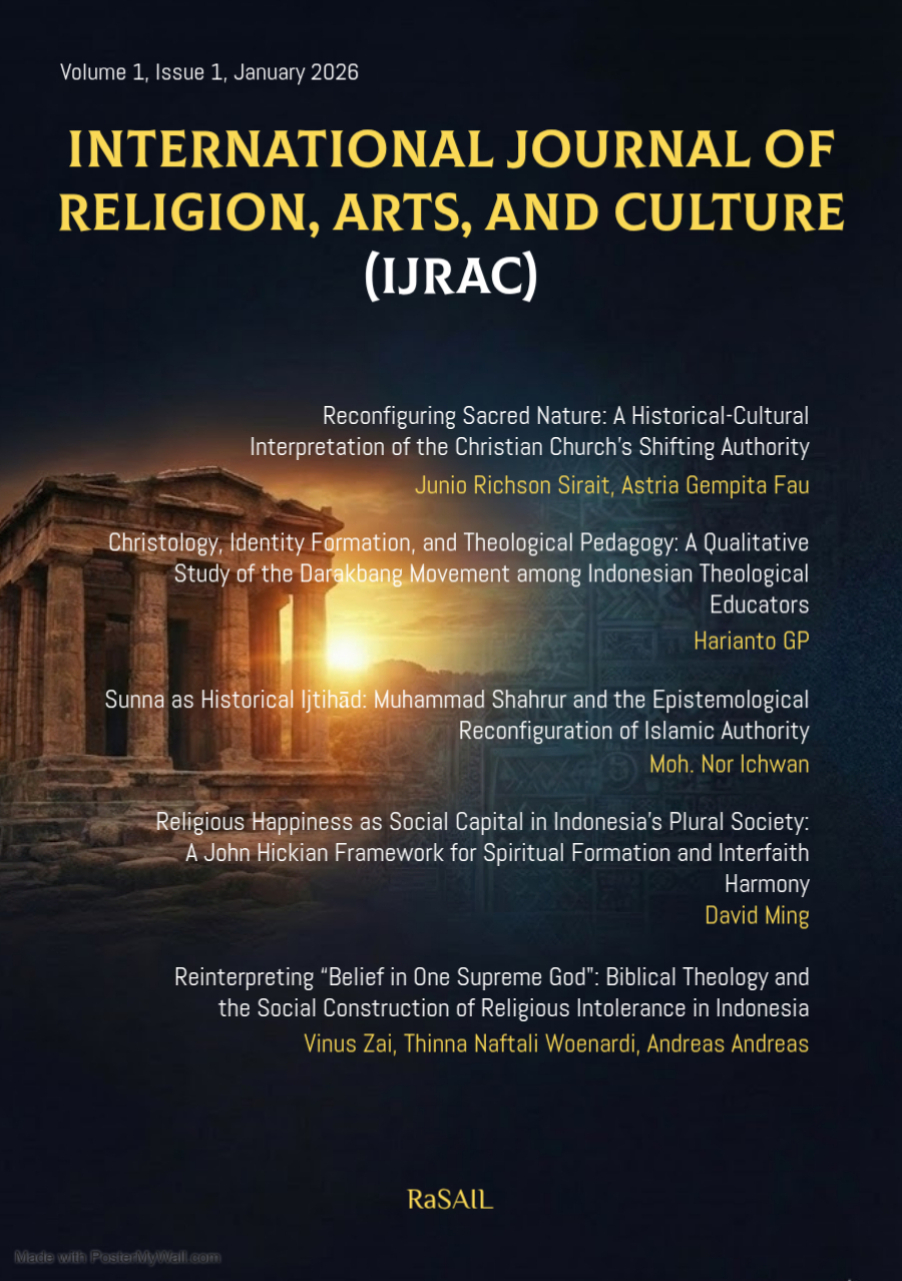
Reinterpreting “Belief in One Supreme God": Biblical Theology and the Social Construction of Religious Intolerance in Indonesia
DOI:
https://doi.org/10.64529/37dd1d03Keywords:
Pancasila, Religious Intolerance, Biblical Theology, Social Construction, PluralismAbstract
This article analyzes the interpretation of the One Godhead (Ketuhanan yang Maha Esa) as the first precept of Pancasila and its relationship to the social construction of religious intolerance in contemporary Indonesia. The unit of analysis of this research is a philosophical, theological, and social discourse that forms the meaning of the first precept in the context of religious pluralism. This study aims to examine how differences in interpretation—particularly between exclusive and inclusive interpretations—affect religious attitudes, public discourse, and social practices related to tolerance. The research method is qualitative, integrating a comprehensive literature review and critical discourse analysis of academic texts, policy documents, religious narratives, and media representations. Key findings suggest that exclusive, literalist interpretations of the One Godhead contribute to the polarization of identity and the legitimation of intolerant practices, while inclusive interpretations that align with biblical theological ethics—such as human dignity, justice, and love—have transformative potential to strengthen social cohesion. This article contributes to the interdisciplinary study of religion and democracy by offering an inclusive conceptual framework for multireligious education based on the philosophy of Pancasila and biblical hermeneutics.
References
Aliansi Demokrasi untuk Papua. (2024). Laporan tahunan kondisi kebebasan beragama di Papua tahun 2023. Jayapura: Aliansi Demokrasi untuk Papua.
Azra, A. (2023). Islam Indonesia: Dinamika intelektual dan transformasi sosial. Jakarta: Prenada Media.
Bakshy, E., Messing, S., & Adamic, L. A. (2015). Exposure to ideologically diverse news and opinion on Facebook. Science, 348(6239), 1130–1132. https://doi.org/10.1126/science.aaa1160
Bauckham, R. (2021). Gospel of glory: The forgotten testimony of earth’s witness. Grand Rapids, MI: Baker Academic.
Berger, P. L., & Luckmann, T. (1966). The social construction of reality: A treatise in the sociology of knowledge. New York, NY: Doubleday.
Bowen, G. A. (2009). Document analysis as a qualitative research method. Qualitative Research Journal, 9(2), 27–40. https://doi.org/10.3316/QRJ0902027
Braun, V., & Clarke, V. (2019). Reflecting on reflexive thematic analysis. Qualitative Research in Sport, Exercise and Health, 11(4), 589–597. https://doi.org/10.1080/2159676X.2019.1628806
Casanova, J. (2018). Public religions revisited. Religion, 48(1), 5–27.
https://doi.org/10.1080/0048721X.2017.1408604
Creswell, J. W., & Poth, C. N. (2018). Qualitative inquiry and research design: Choosing among five approaches (4th ed.). Thousand Oaks, CA: Sage.
Crouch, M. (2012). Law and religion in Indonesia: The Constitutional Court and the blasphemy law. Asian Journal of Comparative Law, 7(1), 1–46. https://doi.org/10.1017/S2194607800000582
Denzin, N. K. (2012). Triangulation 2.0. Journal of Mixed Methods Research, 6(2), 80–88.
https://doi.org/10.1177/1558689812437186
Effendy, B. (2020). Islam dan negara: Transformasi gagasan dan praktik politik Muslim di Indonesia. Jakarta: Paramadina.
Fairclough, N. (2015). Language and power (3rd ed.). London: Routledge.
https://doi.org/10.4324/9781315834368
Ferrara, A. (2019). Religion and democratic pluralism. Journal of Political Ideologies, 24(2), 131–149.
https://doi.org/10.1080/13569317.2019.1603815
Goldingay, J. (2009). Old Testament theology: Israel’s life with God. Downers Grove, IL: InterVarsity Press.
Hassan, R. (2022). Radicalism and fundamentalism in Southeast Asia: The challenge of Islam. London: Routledge.
https://doi.org/10.4324/9781003277704
Hefner, R. W. (2020). Civil Islam: Muslims and democratization in Indonesia (2nd ed.). Princeton, NJ: Princeton University Press.
Hoon, C.-Y. (2018). Putting religion into multiculturalism: Conceptualising religious multiculturalism in Indonesia. Asian Studies Review, 42(3), 476–493. https://doi.org/10.1080/10357823.2018.1473332
Ibrohim, M. O., & Budi, I. (2023). A systematic review of hate speech and abusive language detection. Heliyon, 9(8), e18647. https://doi.org/10.1016/j.heliyon.2023.e18647
Jackson, R. (2014). Signposts: Policy and practice for teaching about religions and non-religious worldviews in intercultural education. Strasbourg: Council of Europe.
https://doi.org/10.1017/CBO9781107449367
Jannah, R. (2023). Pembentukan karakter toleransi melalui pendidikan multikultural berbasis agama di sekolah. Jurnal Pendidikan Agama, 12(1), 45–62.
Juergensmeyer, M. (2017). Terror in the mind of God: The global rise of religious violence (4th ed.). Berkeley, CA: University of California Press.
Komisi Nasional Hak Asasi Manusia. (2023). Laporan tahunan kondisi HAM di Indonesia tahun 2022. Jakarta: Komnas HAM.
Madjid, N. (2021). Islam, kemodernan, dan keindonesiaan. Jakarta: Paramadina.
Magnis-Suseno, F. (2020). Etika Jawa: Ajaran-ajaran filosofis dan wawasan hidup orang Jawa. Jakarta: Gramedia Pustaka Utama.
Maarif, A. S. (2021). Islam dan politik: Mencari makna di tengah badai. Bandung: Mizan.
Mujiburrahman. (2020). Jejak langkah pemikiran liberal Islam di Indonesia. Yogyakarta: Pustaka Pelajar.
Müller, J. (2020). Human dignity and imago Dei. Journal of Reformed Theology, 14(1), 21–38.
https://doi.org/10.30965/15697312-01401003
Nasution, H. (2021). Islam ditinjau dari berbagai aspeknya. Jakarta: UI Press.
Notonagoro. (2022). Pancasila secara ilmiah populer. Yogyakarta: Gadjah Mada University Press.
Pusat Studi Agama dan Demokrasi. (2022). Laporan tahunan indeks toleransi beragama di Indonesia. Jakarta: PSAD.
Said, A. (2021). Teologi pluralisme: Membangun kerukunan antarumat beragama. Yogyakarta: Kanisius.
Setara Institute. (2024). Laporan kebebasan beragama/berkeyakinan (KBB) di Indonesia tahun 2023. Jakarta: Setara Institute.
Setiawan, E., Scheepers, P., & Sterkens, C. (2020). Interreligious conflicts in Indonesia: Social identity, religious ideologies, and support for intergroup violence. Asian Journal of Social Psychology, 23(3), 331–345. https://doi.org/10.1111/ajsp.12397
Setiawati, E. (2022). Integrasi pendidikan multikultural dalam kurikulum pendidikan agama Islam. Jurnal Pendidikan Islam, 7(2), 115–132.
Simanjuntak, H. (2021). Pancasila dan pluralisme agama di Indonesia. Jakarta: Penerbit Buku Kompas.
Siregar, R. (2023). Peran media sosial dalam penyebaran hoaks dan ujaran kebencian berbasis agama. Jurnal Ilmu Komunikasi, 15(1), 67–84.
Supriatna, E. (2023). Filsafat Pancasila: Kajian ontologis, epistemologis, dan aksiologis. Bandung: Pustaka Setia.
Surbakti, N., & Harahap, N. (2022). Implementasi perda bernuansa syariah dan dampaknya terhadap kebebasan beragama di Indonesia. Jurnal Hukum dan Pembangunan, 52(1), 1–23.
https://doi.org/10.21143/jhp.vol52.no1.2996
Suryadinata, L. (2020). Pribumi dan Tionghoa: Beberapa perspektif dan masalah. Jakarta: Gramedia Pustaka Utama.
Tajfel, H., & Turner, J. C. (1979). An integrative theory of intergroup conflict. British Journal of Social Psychology, 18(1), 33–47. https://doi.org/10.1111/j.2044-8309.1979.tb00734.x
Wahid Foundation. (2023). Laporan indeks kualitas kehidupan beragama di Indonesia. Jakarta: Wahid Foundation.
Wahyudi, J. (2024). Literasi digital dan tantangan radikalisme agama di era disrupsi informasi. Jurnal Kajian Komunikasi, 18(1), 1–18.
Wright, N. T. (2006). Simply Christian: Why Christianity makes sense. New York, NY: HarperSanFrancisco.
Yusuf, A. A., Shidiq, M., & Hariyadi, H. (2020). The determinants of religious intolerance in Indonesia. Religions, 11(1), 21. https://doi.org/10.3390/rel11010021
Downloads
Published
Issue
Section
License
Copyright (c) 2025 Vinus Zai (Author)

This work is licensed under a Creative Commons Attribution-NonCommercial-ShareAlike 4.0 International License.